Your workspace, available to your own systems.
A versioned REST API across accounts, contacts, opportunities, tickets, invoices and more — authenticated with keys you scope yourself.
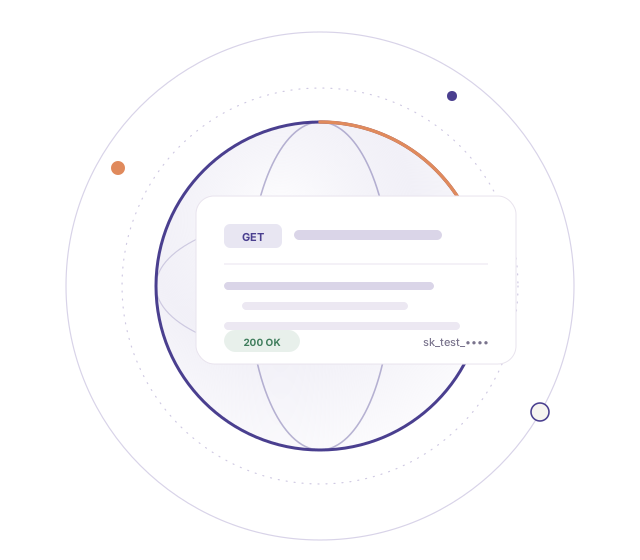
Fifteen resources under one versioned namespace.
Accounts, contacts, leads, opportunities, quotes, invoices, tickets, tasks, activities, account notes, knowledge base, widgets, unsubscribes, stats and transactional email — all under /api/v1.
Errors come back in a consistent shape, and every request is logged against the key that made it, with the endpoint, the status and where it came from.
Read the documentation — guides for authentication, pagination, errors and rate limits, plus a page per endpoint generated from the OpenAPI document.
Only what that integration needs
Set per key
Keys can be retired
Built for people who will read the error message.
The parts that make an API usable rather than merely present.
A key is shown once
Only a hash is stored, so a leaked key can be revoked but never re-read.
Test and live are separate
Sandbox keys are prefixed sk_test_ and act on sandbox data, so an integration can be built without touching real records.
An OpenAPI description
The surface is described in OpenAPI 3, not just in prose.
Send your own transactional email through it.
Trigger receipts, alerts and confirmations from your own systems, by template or with inline HTML, over the same authenticated API.
They go out through your verified sending domain, with the same suppression and delivery handling as everything else the product sends.
From a key to a working integration.
Nothing here needs a conversation with sales first.
Create a key
Scope it to what it needs.
Build against sandbox
sk_test_ keys, sandbox data.
Go live
Switch the key, not the code.
Watch it
Requests are logged per key.
Put the workspace behind your own systems.
A REST API, scoped keys and transactional email, in the same product as the records.